
I’ll admit I’m probably late to the party on this one, but I just found out about it. One of the dreams that I’ve had about my writing career is that I might someday be considered to win the great science fiction awards, the Hugo and Nebula. Of the two, I always personally felt the Nebula carried more weight because it’s voted on by the actual writers, members of the Science Fiction and Fantasy Writers of America.
The SFWA apparently changed their rules wording last year and now bars from consideration any work that has used AI in any form at any point in the writing process. I hate to break this to them, but Google Docs has Gemini built in. Microsoft Word has Copilot built in. If you’ve used one of the two major word processors, hey, guess what? You don’t qualify for a Nebula!
In the official rules for the Nebula awards, point 9.11.2, they state: Works that used LLMs at any point during the writing process must disclose this upon acceptance of the nomination, and those works will be disqualified.
I’m sure that’s not what they meant, but according to the letter of the law, anything made with current versions of Google Docs or Microsoft Word, or used tools like Grammarly, is automatically disqualified. Now, that sounds ridiculous because it is ridiculous, but that’s what this witch hunt has brought us to, and frankly, I’m a little salty about it. (You can tell.)
Here’s the reason I’m pissed: I wanted to win a Nebula. I’m not saying that anything that I’ve already written is good enough, but someday. Unless they change the rules, I’m automatically disqualified. Now you might ask, “Why am I automatically disqualified?” Even if they clarify, “Well, of course you can use word processors,” I’m still out.
Here’s why: don’t tell anybody, but I’m disabled. I have AuDHD and dyslexia, and I frequently use AI—not to generate a single word of the manuscript—but to converse about the project at various stages, to help me brainstorm, to help me sequence the outline, to help me revise and polish.
Again, I stress that the AI at no point has write-access to the actual manuscript. Every word, every decision is my own, but because I have these conversations—and because I need these conversations as a protected assistive technology for my disability—the SFWA has decided that I’m not a real writer and that nothing I produce is worthy of consideration. (And despite their mealy-mouthed apology issued just days after the rule change, the rules currently include the clause quoted above.)
The SFWA, not to put too fine a point on it, can bite me. They’re short-sighted, discriminatory, and ultimately on the wrong side of history. They will lose.
The more troubling problem here is that they’re not alone. Every time I turn around, I see an article, video or podcast decrying the use of AI in literature without making the distinction between AI helping the writer and AI being the writer. This nuance gets compressed down every time into the assumption that if you used AI in your writing process, you’re lazy, cheating and outsourcing your thinking to a machine. The underlying conceit seems to be that the only reason anyone would use AI at all is to generate the final text.
But that’s not what I’m doing, and I’m not unique. I’m having a conversation with AI, getting feedback, brainstorming and generally just using it as an advisor. And the catch is that none of that would be disqualifying at all if I was talking to a human. If I had these exact same conversations over chat with a developmental editor, not only would the authorship still be mine, but I wouldn’t even have to credit the editor (though a nod in the acknowledgements is always nice). If I got feedback from a critique group, I’m fine. If I talk about the book and the writing process with my therapist, no harm done. But as soon as I have any of these conversations with ChatGPT, I’m cheating and a fraud.
This has to stop. I know AI can be an emotional topic. My own daughter shuts down whenever I mention talking to ChatGPT, and refuses to read my books. I get that there are a lot of hurt feelings about how the models were originally trained on pirated material. I get that people have concerns about resource usage. A lot of people hear “AI,” see red, and stop listening.
But for disabled people, this technology has been life-changing, and I’m tired of being excluded for using an assistive technology that people can’t be bothered to understand. AI didn’t write my books. I did. And who I discussed the books with should have no bearing on the finished product.
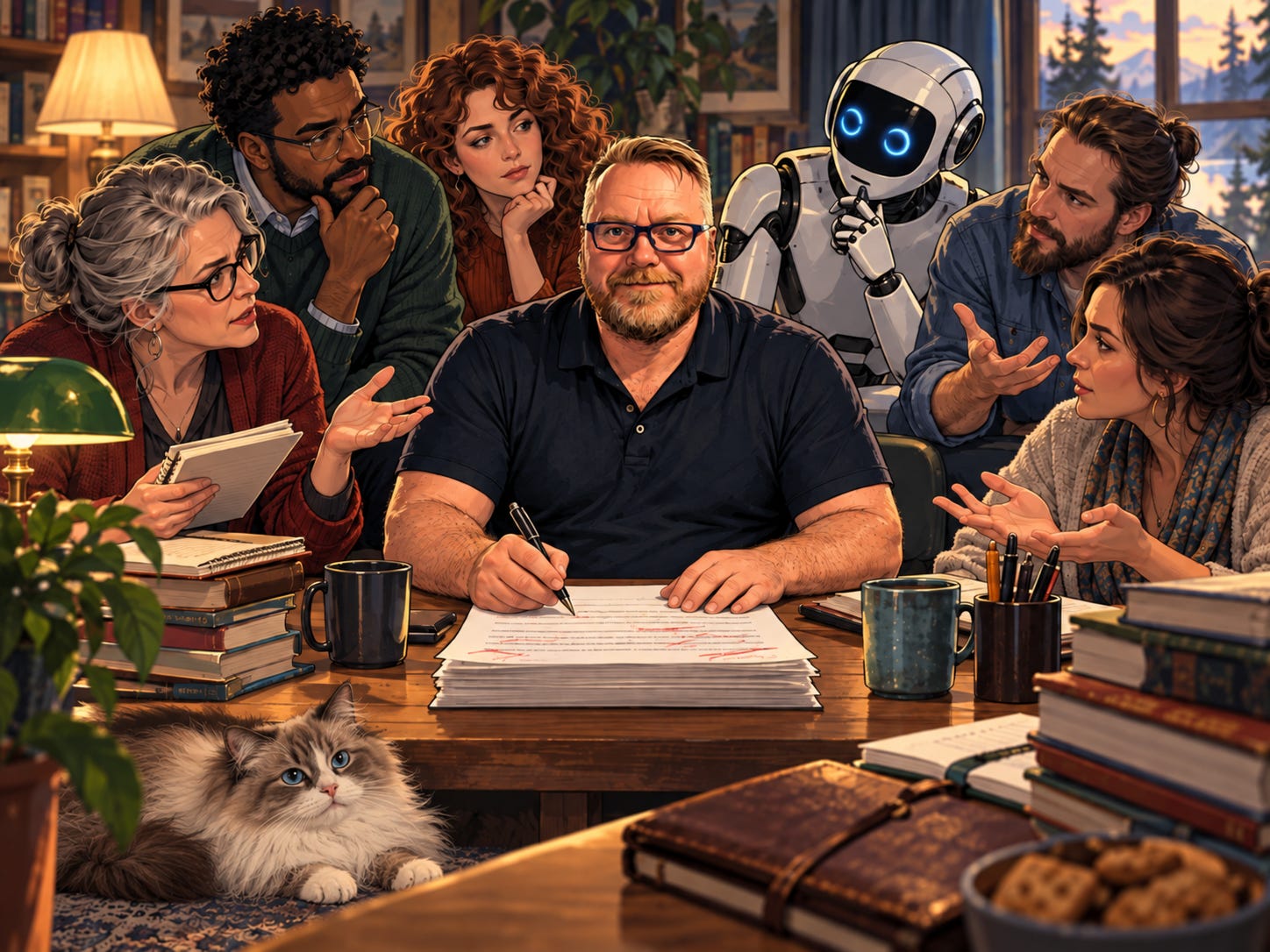
Like I said, my AI never has write-access to the manuscript. Every word is my own. Don't even take recommended text, which writers absolutely do all the time from human editors.
Since I know people will ask, "well, can't you just not use the AI features in Docs or Word?" how would you prove that? If you use Find and Replace in Google Docs, do you know, for a fact, that the feature hasn't been "enhanced" by Gemini under the hood, perhaps to find variants of words? You don't know that, and short of code inspection of Google's closed source code for Google Docs, you can't know that. So you cannot, ethically, state that an LLM has never had access to your manuscript if you use Docs or Word.