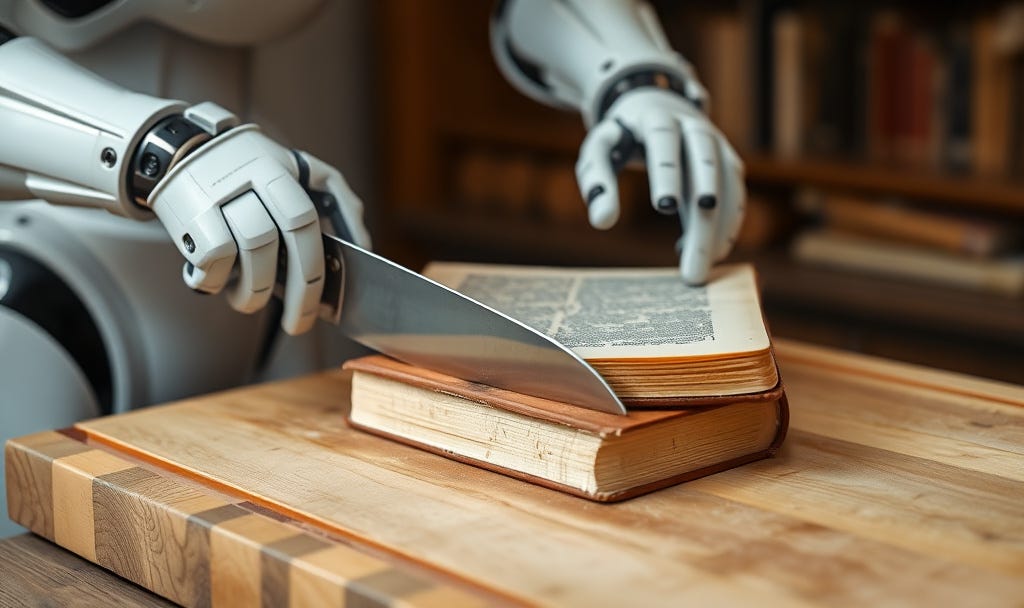
Years ago, Google scanned as many books as they could find into Google Books, usually borrowing from libraries, using a patented non-destructive method to scan the pages and returning the books. This got howls of protest, too, at the time, from people claiming this was “stealing,” but the courts upheld it as Fair Use. Recently, Anthropic hired the same guy that ran that Google project and directed him to build a similar collection to train the AI models. But the difference was they didn’t want to take the time or license the process to do the non-destructive scan. Instead, they bought books by the millions, chopped off the spines and ran them through a scanner, discarding the pages afterward.
This has also been ruled in the courts as Fair Use, and actually has a stronger legal basis than what Google did. Google was arguably creating a new copy of the work without permission, but the judge ruled that Anthropic was using books they legally purchased, destroyed each copy after scanning and kept the resulting data internally rather than redistributing them. Thus this was a “transformative” conservation of space, which is perfectly legal under US law.
Legal or not, it pissed people off.
I’ve seen tons of think pieces and videos on this, comparing what Anthropic is doing to Nazi book burnings. “They’re destroying books!” they opine, as if that’s all the argument they need to make. The concern was that some of the books might have been rare, maybe even one of a kind. And the hedging language in that previous sentence is deliberate—despite used bookshops receiving obscure, oddly specific orders, there is no proof that Anthropic destroyed rare, antiquarian books for this project, and in fact they have explicitly said they did not. A lot of people don’t believe them because they’ve already made up their minds that AI companies are evil, built on theft, and of course they’re lying.
The irony is that the whole reason Anthropic is doing this is because of the backlash from their previous efforts to train AI on the written word. They have gotten in legal trouble for using pirated material, so this time they found a way to use the First Sale Doctrine to do things entirely legally, and they’re still getting compared to Nazis.
But there’s a few important distinctions here, because of course there are. First, the Nazis were destroying books to remove the ideas from society, destroying information. Arguably, Anthropic is doing the opposite. Every book they scan teaches Claude, and allows it to converse and explain the contents. Filtered through the AI, the information is preserved for future generations, not destroyed. There’s a caveat to this, but we’ll get back to that later.
Secondly, even if they were chopping up rare books to do this—and again, they deny that and there’s no proof that they’re lying—that’s entirely their right as the owner of the book. There is nothing inherently sacred about a book as a physical object. The real “book” is the content, not the codex. Even a rare book is just wood pulp, ink and glue. And when you buy a physical object, you have the right to do what you want with it, including destroying it.
So the bigger argument is if these books were so precious and irreplaceable, what were they doing for sale in the first place? Shouldn’t they have been in libraries, or even museums? If they were that rare, it should have been impossible for them to be privately owned. If you have a complaint, take it up with the sellers, the bookshops that provided the books in the first place.
Of course, many of those shops often had little idea what they had. One of the ones referenced had half a million tomes in their warehouses, just sitting there in the dark gathering dust. The end of “Raiders of the Lost Ark” comes to mind. At least the books fed into Claude were put to use. Is there a functional difference between something destroyed and merely lost forever, locked away from human sight or memory?
And this is the only way a lot of these books could reach the public. Thanks to the House of Mouse and their relentless pursuit of eternal copyright to prevent “Steamboat Willie” from falling into public domain, a fight they finally lost just a few years ago, copyright is now 70 years after the death of the author, or 95 years from publication for commissioned works. This means virtually everything created in the 20th century is still under copyright, and in most cases, no one even knows who the rights holders are. Such “orphan copyrigtht” works can no longer be reprinted, and as the last copies vanish into landfills or warehouse stacks, they are lost to human use. At least this way, they become part of Claude’s corpus of knowledge, and even though it can’t regurgitate them verbatim—contrary to popular belief, AI doesn’t work that way and isn’t a “plagiarism machine”—it can at least discuss the information they contained.
Now, one of the reasons this worked legally is actually one of the most valid concerns from a preservation standpoint. The information these books contained is still not available to humanity as a whole. It belongs to Anthropic, not the public. And thus if you want to know it, you have to talk to Claude. Destroying the post-scan pages and keeping the data to themselves may have shielded Anthropic legally, but it is still a net negative for society if you don’t have a Claude subscription.
So maybe there’s an opportunity for regulation here. We could pass laws explicitly declaring this kind of training to be legal, but also require the scanner to keep the scanned text after feeding it into the AI, and maybe after a suitable exclusivity period, releasing it to the public so it can be put to other uses. This would require overhauling copyright to release orphan works, but it would mean that the collected knowledge of our species wouldn’t be limited to one corporation.
But as for what Anthropic is really doing, no, they’re not butchering rare and priceless books, and they’re not stealing anything. They’re preserving human knowledge inside Claude and they’re doing it in a way that negates the previous accusations of theft.
Anyone who tells you differently… is selling something.
Further Reading