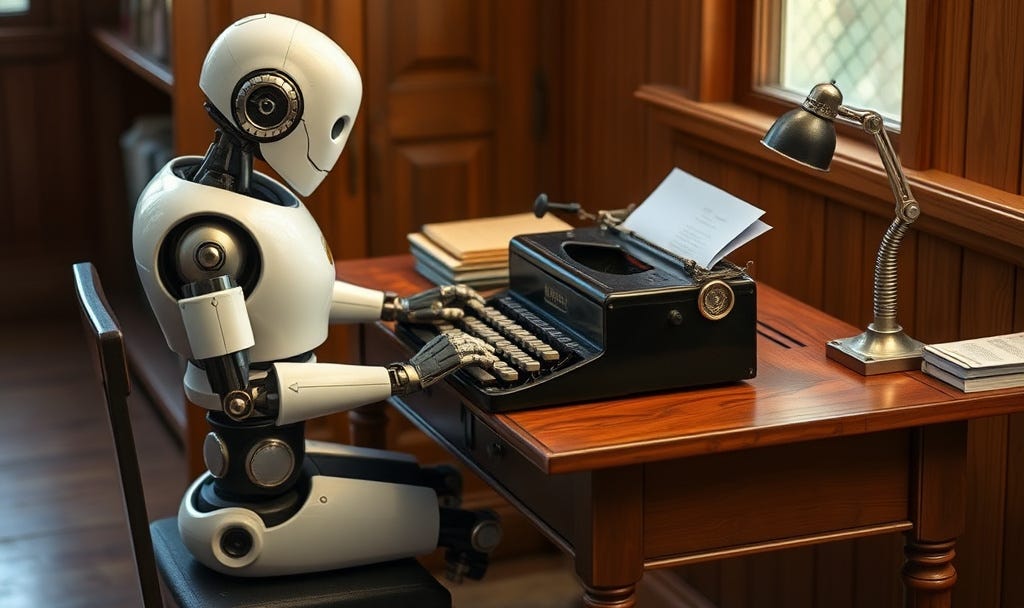
AI doesn’t just write like a human. It writes like a specific kind of human, and we’re in danger of treating those natural voices as evidence of fraud.
I got into a discussion on Substack the other day with a person who was convinced that she could “always tell” when something was written by AI. By now, I’m sure you all know the tired litany of crimes:
Use of the dreaded em dash
Antithesis juxtaposition, the “it’s not X, it’s Y” that I used in the topic paragraph above
Clean, structured arguments
The rule of three, which I’m deliberately placing as the fourth bullet here
People say that AI has a “voice,” a recurring grab bag of phrases and rhetorical techniques that once you see it, you can’t unsee it. It jumps out at you. “Aha!” you say. “I smell a robot!”
Except, you don’t. But I’m not going to try and tell you that you’re imagining things. The patterns described by these oft-cited heuristics do exist. But they’re not what you think they are.
See, AI didn’t make these up. As AI detractors are quick to point out, AI can’t invent anything out of whole cloth (I would argue that humans can’t either, but that’s a different post). AI, by definition, is mid, an averaging machine that produces run-of-the-mill whatever it produces. It’s just a function of the training data it processed and digested into the web of relations and patterns it uses to generate new data.
So then how did AI learn to write like this? Because it does use em dashes more than most people. It does use the rule of three. It does use antithesis. Why does it do that?
Because a lot of the text it was trained on was written that way. Written by people who think in structure and patterns, who think in lists, who think in relationships. People who have spent lifetimes working hard to be understood in a society that consistently misreads them.
It’s no secret that fields like copywriting and technical writing selected for people with neurodivergent traits. While an astonishing percentage of autistic adults are unemployed—unable to hold a job in a hierarchical, late-capitalistic society rife with unwritten expectations and that values compliance and consistency more than innovation—those that did manage to make a living often did it by using the written word to convey complex concepts in simple language. Documentation rewards precisely the things that neurodivergent people bring to the table: deep institutional knowledge, logical structure, and a love for elegance in communication.
So it stands to reason that the percentage of training data fed to AI models that was written by neurodivergent people is significantly higher than their representation in the actual population. On average, AI writes like an autistic person.
Which is fine until the AInquisition starts weaponizing that, inverting it and saying that anyone who writes like an AI must be letting the AI write for them, producing “AI slop.” Careers have been ruined without proof, because in a witch hunt, accusation is proof of guilt. And all people need to lodge an accusation is a vibe, a lazy heuristic, a percentage spit out by an “AI detector” that even the companies that make them admit isn’t proof of anything.
I get why creatives are scared of AI. And fear makes people do things they wouldn’t otherwise do. But before you attack someone for “AI slop,” consider that they might not be passing off computer-generated text as their own. They might be the kind of person the computer learned to mimic. And if you can’t tell the difference between text written by an AI and text written by an autistic, there’s no harm in staying quiet, keeping your suspicions to yourself and not hurting a real human being that you don’t understand.