
As every reviewer seems to take glee in pointing out, foldables are expensive. The Z Fold 8 starts at $1900 here in the States, and it’s no cheaper around the world. So it’s only natural to want to protect it with a case. I get that. I’ve bought—consults notes—ten cases for the Z Fold 8 so far, ranging from under $20 to more than $80. They range from the minimal, barely there aramid fiber of the Thinborne to the chonky and indestructible plastic dbrand Grip Case. And because Samsung still doesn’t see fit to include a magnetic ring around the induction coil, using one of them is required to use the plethora of MagSafe accessories I have, mostly chargers and stands.
And yet, I’m leaning toward not using a case at all.
Well, I’m not crazy. Let’s say that Samsung Care+ is my case. I’m paying $18/mo for accidental damage and theft coverage, so if anything happens to my Z Fold 8, Samsung will give me another one after I pay a deductible. But that’s still a hassle, and why risk it? Well, because size—and weight—matters.
Naked Robotic Core
Let’s start with what Samsung actually designed. By my measurements, the Z Fold 8 is 82 mm wide, 123 mm tall and 10 mm thick when closed. On my cheap kitchen scale, it weighs in at 206 grams. (I did put the Samsung anti-reflective film on the front screen, so it has the same anti-glare as the inner screen. Also, props to Samsung for making that easiest application of a plastic screen protector I’ve ever done, perfectly straight and no bubbles.) The back can be a little slick because of whatever they did to make it show no fingerprints, but it’s easy to hold the device in one hand and reach all the way across it when typing one-handed or playing solitaire. The phone feels solid, but light enough to be agile in your hand.
Snap it open, and you have a tablet the same size as the original iPad Mini if someone chopped off the bezels. And again, that 206 grams spread over that area feels so light that my Kindle Paperwhite (despite being 209 g) feels chunky in comparison.
This is the experience that Samsung’s designers intended. But there are things that drove me to try to enhance it.
First, as mentioned before, this is a $2,000 phone and the back can feel a little slippery. Not a great combination. So adding something that would enhance both durability and grip sounds like a no-brainer.
Second, the device doesn’t support magnetic ring attachments on its own, so the first thing people usually consider to help hold a device, a Pop Socket or ring, also needs a case.
And lastly, because the bezels on this thing are so minimal, it’s difficult to manipulate the device with my thick meat fingers without inadvertently interacting with the screen. Particularly accidentally selecting a different YouTube video than the one I’m trying to watch when I put my phone into stand mode. So maybe the iPad still has sizeable bezels here in the enlightened year 2026 because they serve a purpose.
And bonus point, another thing the reviewers keep pointing out, particularly in comparison to the Pixel 11 Pro Fold, is that the Z Fold 8 only has IP48 protection, meaning while it’s reasonably waterproof, it’s only good for dust and debris ingress of 1 mm or larger. Most sand and all dust is smaller than 1 mm, so it seems like it’s just asking to get crap into that hinge, gumming up the works over time.
So let’s see what we can do about that.
Stand in the place where you live
Before we get started, we need to talk about stands. None of the cases I’m going to talk about have built-in stands, so to use the phone while your hands are doing something else—like typing or eating—you need something to hold it. If the stand attaches directly to the phone, you’re more likely to take it with you, but that also adds weight and bulk to the phone. For each case, I’m going to show you a stand I think pairs well with it, along with pointing out the compromises that entails.
dbrand Grip Case
I saw a video review of the dbrand Grip Case that seemed almost impossible. The reviewer went as far as to throw the phone at a basketball hoop in his garage, letting the case fall to the concrete floor, and the phone was completely unscathed. This would be the case for me, I thought.
And it’s great. The dbrand case completely wraps the phone on all six planes (front, back, all four edges) in impact-resistant plastic. The hinge protector is spring-loaded and magnetic, so it clacks over the hinge with a satisfying snap. The whole case has a micro-texture that makes it feel almost like sandpaper, and it’s extraordinarily grippy. It doesn’t include an integrated screen protector, which a lot of full-protection cases do, which I appreciate because I already have the anti-reflective film and don’t need yet another layer interfering with clarity and touch response. And it even supports dbrand’s own skins, so I got mine with a genuine leather back. The leather makes the phone feel like a fine, if small, leatherbound book, and the textured plastic feels remarkably like the early plastic Palm Pilots. It was exactly what I wanted.
But…
All that protection adds significant weight and bulk. Fully encased, the closed phone is now 5 mm wider at 87 mm wide, 129 mm tall and 14 mm thick. The case by itself weighs 51 g, and that means the phone with the case weighs 258 g, about the same as the Moto Fold. Those dimensions don’t sound like much, but the thickness of the hinge-protecting spine now made it awkward to reach the far edge of the screen, since I’m a southpaw and hold the phone in my left hand. That spine gave me something to pull against when the phone was open, making it easier to grip, but the weight of the phone also made it more tiring to hold over the course of a 42-minute TV show. The raised bezels around the cover screen allowed me to put the phone face down and not worry about scratches, but they also made edge gestures for back and multitasking more awkward to start. The thickness of the bezels when open gave me ample space to put my fingers without touching the screen, but they also made it more challenging to type.
I found that I loved the case for what it did, but it also made the phone less fun to use. And if I added a metal magnetic stand (see below), it got even heavier. Add the Kenu Stance+ to it and we’ve got a handheld load of 327 grams, nearly three quarters of a pound in American.
So for this case I found a separate stand that doesn’t attach magnetically to the phone. It’s light, but it’s bulky at nearly six inches long. But what’s great about this stand is that the legs spread out to give the phone a rock-solid base, even when open in landscape, and then the foldable arm can support the spine of the case directly so there’s no wobble. It’s a clunky addition to an already clunky case, but the ship has already sailed on traveling light.
All that said, while I still intend to use the dbrand Grip Case when I travel, it’s simply too much for day to day. It fundamentally changes the geometry of the phone, and makes it into a different device. I decided to go for something simpler.
Hensinple One-Piece Case
Okay, technically, this is called Magnetic for Z Fold 8 Case,Samsung Galaxy Z Fold 8 Case(Fit for Mag-Safe)Translucent Matte Military Grade Rugged Protection Shockproof Protective Hard Phone Case,Black. But I’m not calling it that.
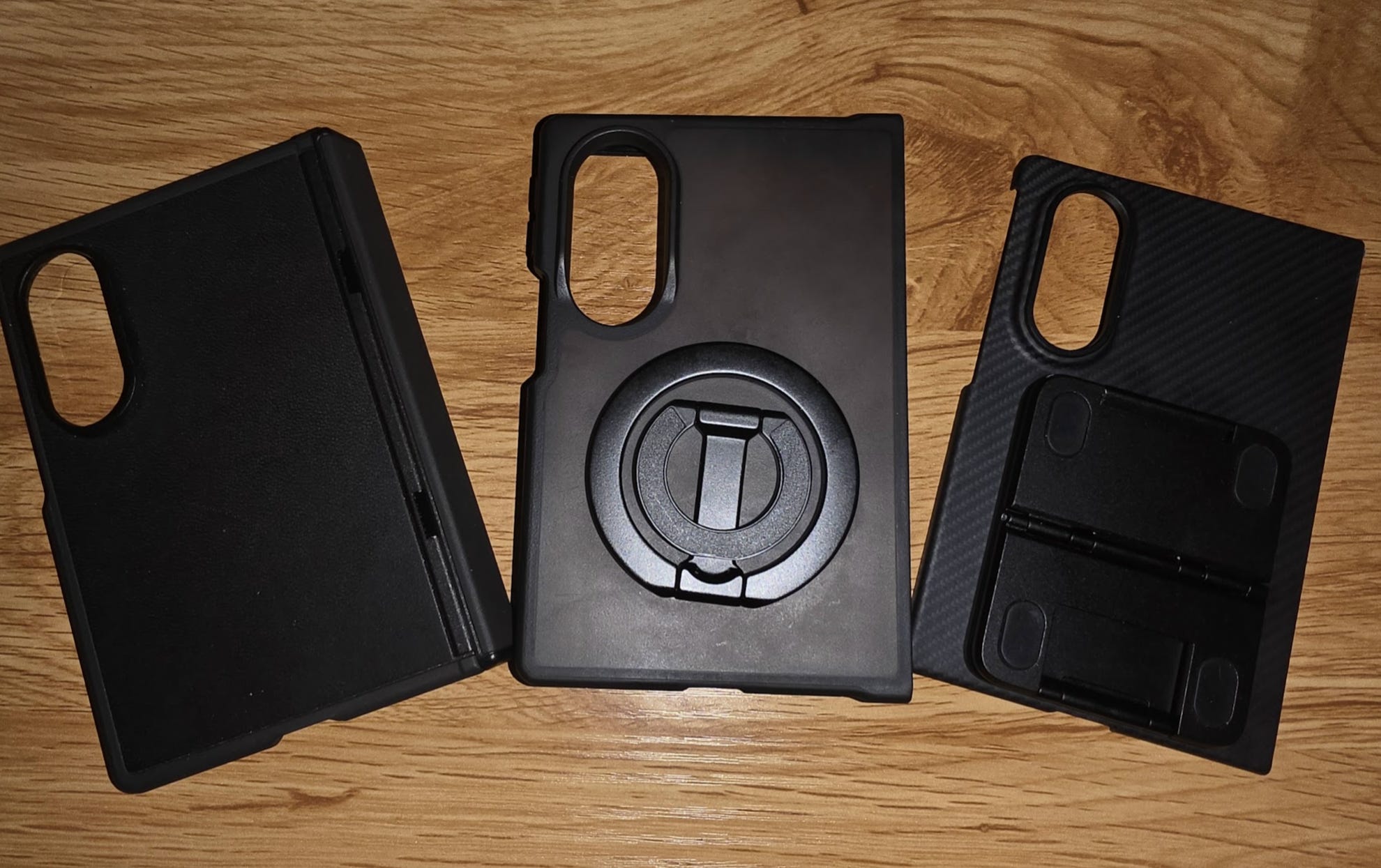
It is one of my favorite cases, though. I had the same design for the Z Fold 7 and it was one of my go-to cases. It’s a single piece with a clever hinge on the top and bottom so it can bend with the phone while still providing five planes of protection. What it doesn’t do is cover the hinge, but that might be what we’re looking for to keep down on extra width. And on the other edges, it’s about as thick as the dbrand case, so I’d still have the ability to fold and maneuver the device without errant taps on the screen, and it has cutouts to make back and multitasking gestures easier. It also lacks an integrated screen protector, cutting down on weight.
What I love about this case is the one-piece design. Because it has its own hinge, you don’t have to worry about using adhesive strips to secure the front piece, and the whole case goes on and off very easily. A lot of foldable cases treat the front half of the phone as an afterthought if they protect it at all—looking at you, Samsung—and it’s nice to have a relatively inexpensive case that still provides all-around protection. It doesn’t cover the hinge, but because it doesn’t have that spine in the way, it also lies flat on a table or flat wireless charger.
And… it’s fine. The case does the job, and phone is both protected and MagSafe-ready. This is probably the best case for most people, which is nice because it’s also the cheapest. But just days into using it, I started to bristle.
The case itself weighs 40 g, so the phone in it weighs 246 g. Add the MagSafe stand ring below, though, and you add another 51 g and we’re pushing 300 again. The device measures out at 84 mm wide, 128 mm tall and 14 mm thick, nearly identical to the dbrand case but 3 mm narrower. The bezels are big enough to be protective and give my fingers purchase, but they get in the way of actually using the screen, too, though the 3 mm saved by not having a hinge protector makes all the difference reaching stuff with my left thumb.
Every time I took a case off, I was struck at how elegant and light the phone was without one. Maybe I could get a case that granted some protection and added a MagSafe ring, but didn’t appreciably add to the size or weight of the device. It was time to get my fiber.
Thinborne
If you’re looking at aramid fiber cases, the best choice is Thinborne. They use the highest quality fibers, the tightest weave and result in cases that are fractions of a millimeter thick and feather light. I used a Thinborne case on my Z Fold 7 longer than any other case, so I had of course preordered the Z Fold 8 version before I even bought the phone.
The Thinborne case comes in two pieces, a front and back. I had a love/hate relationship with the front piece on my Z Fold 7. It’s so thin and light that you have to use the included adhesive strips to get it to stay on the phone at all, but I found that the strip running down the left side of the screen by the hinge had a tendency to bend, smearing adhesive residue on the screen and constantly collecting lint. So I had a choice: deal with that constant annoyance and use the front piece, or leave it off and deal with the constant annoyance of the asymmetry with the back of the phone just ever so slightly bigger than the front. I already knew what the first one was like, so I went with the latter and left the front piece in the box. This had the side effect of simulating the actual Samsung thin cases, which don’t even include a front piece. A lot of case makers have seemingly decided that only the back part of a foldable is worth protecting.
But as I said, Thinborne cases are so thin that we’re talking about less than a millimeter. Enough to throw off my autistic sense of order, but not enough to change how the phone works. And with the Thinborne case, the phone is very, very nice. The case only weighs 15 g, so it only makes the phone 221 g. The reach and agility of the phone are essentially identical to no case at all. The feel of the aramid fiber is pretty close to smooth leather, and provides excellent grip. And it does include a very strong magnetic ring, allowing me to not only use MagSafe chargers, but add magnetic grip/stands like the one above or this very versatile number from Kenu, which is practically a Transformer.
Of course, that Kenu stand is also 69 g by itself, so adding it to the Thinborne case gets us into OG Pixel Fold territory, the heaviest of US foldables at 283 g. And something I noticed about both MagSafe stands is that you have to take them off to charge, so you’re constantly popping it on and off, and inevitably not putting it back on when you pull the phone off the charger and walk away.
So I started thinking about if magnetic charging and accessories were really doing me any good. One of the nice things about the Z Fold 8 series is that they support 45 W wired charging, which is fast enough to get you from 0 to 50% in half an hour, but not so ridiculously fast that you have to worry about heat and battery longevity. And as it turns out, when I’m lounging in my recliner at home, sleeping, driving or even sitting at my desk at work, I have USB-PD chargers and cables available to me. I popped off the Thinborne case and looked again at the naked phone. Could I just plug it in and carry a separate stand that can stay in my pocket when not in use?
Gimme some skin
Well, maybe not just that. The back of the phone is still pretty slick when my hands are dry, and I live in the high desert of Denver. I need something to give it a little more grip, but that doesn’t have to take up any space or weight. I needed a skin.
I’ve got three on the way, and I’ll decide which I like best. The first is this skin from SopiGuard. The 3M Satin Silver Metallic should match nicely with the “starlight” aluminum of my Cream colorway, and complete the callback to the Palm V/Tungsten E devices I loved so much and that the Z Fold 8 clearly emulates. But if it looks cheap—or I get bored with it—I have two skins coming, eventually, from dbrand. One is a basic plastic matte black, and the other is the same black leather I have on the back of the Grip Case. Either of those should give me excellent grip while not changing the geometry of the device much (the leather is thick enough that you do notice it, especially when the device is open, but I’ll live). And yes, I realize that in the end I've taken this $2,000 device and, between the anti-reflective film and the skin, slap stickers onto all the glass, front and back, but sometimes that's just the way it goes.
For stands, I wanted something that would fold flat and live in my pocket. The best one I’ve found is this JSAUX stand. It’s weighty at 103 g, making it exactly the weight and nearly the size of one half of the phone itself, but it’s stable and rides easy next to my wallet in my jeans pocket. Not attaching it to the phone when not in use makes a difference.
And if I do happen to forget it, I have another stand in the wallet itself. This Nite Ize stand is flimsy, but it gets the job done in a pinch and it collapses down to the size of a credit card.
Less is more
I saw a review of the Z Fold 8 where the reviewer said something I’ve been waiting to hear. He said that while he wasn’t sure about the Z Fold 8 at first because of all the places where it fell short of other foldables when looking at the spec sheet, as he’s used it over several weeks he’s come to realize that those omissions actually make it a better user experience. A larger screen is just extra bulk if that extra space is wasted by an inefficient shape. No telephoto camera and a really good main sensor are actually better than a bad, low-res telephoto taking up space. This is something I picked up intuitively when the Z Fold 8 first came out, but it’s nice to see the spec sheet boys coming around on it.
But it strikes me that this ethos extends beyond just the phone. I think for me the best case is no case at all. I’m reasonably careful with my electronics, and can count on one hand the number of times I dropped my Z Fold 7 and still be able to count off some rock & roll. And with enough finger traction, the Z Fold 8 is so much easier to hold, thanks to the shape and weight. So I think I’m going to take my chances with Samsung Care+ and use the Z Fold 8 as it was designed to be used, and really enjoy the elegance of this remarkable device.