
Later this month, Samsung is going to announce their new foldable phone, the Galaxy Z Fold 8. By modern standards, it looks impossibly short and squat, but it’s actually drawing on a lineage of mobile computing that Samsung might not even be aware of. The phone is 124 mm tall by 82 mm wide when closed, almost 10 mm thick and 201 grams in weight. Most flagship slab phones these days are 150-160 mm tall and closer to 75 mm wide, giving them a roughly 2:1 aspect ratio, twice as tall as they are wide. Most foldables on the market today mirror slab phone dimensions, with tall, narrow screens that open into roughly square tablets.
It didn’t used to be this way. But to see how we got here and why the Z Fold 8 gets it right again, we have to look at how this all got started.
Back in the 1990s, Jeff Hawkins had an idea. He thought he could make a handheld computer that people could use in place of a bulky paper day planner, something relatively inexpensive, reliable, running on simple alkaline batteries. To test the design, he carved prototypes out of blocks of wood and carried them around in his pockets—shirt and pants—pulling them out during the day to pretend to check appointments, jot notes, cross off tasks. After a lot of experimentation with different sizes and shapes, he settled on a form factor that felt good in the hand, was big enough to do the job, but small enough to be comfortably pocketable. And the Palm Pilot was born.
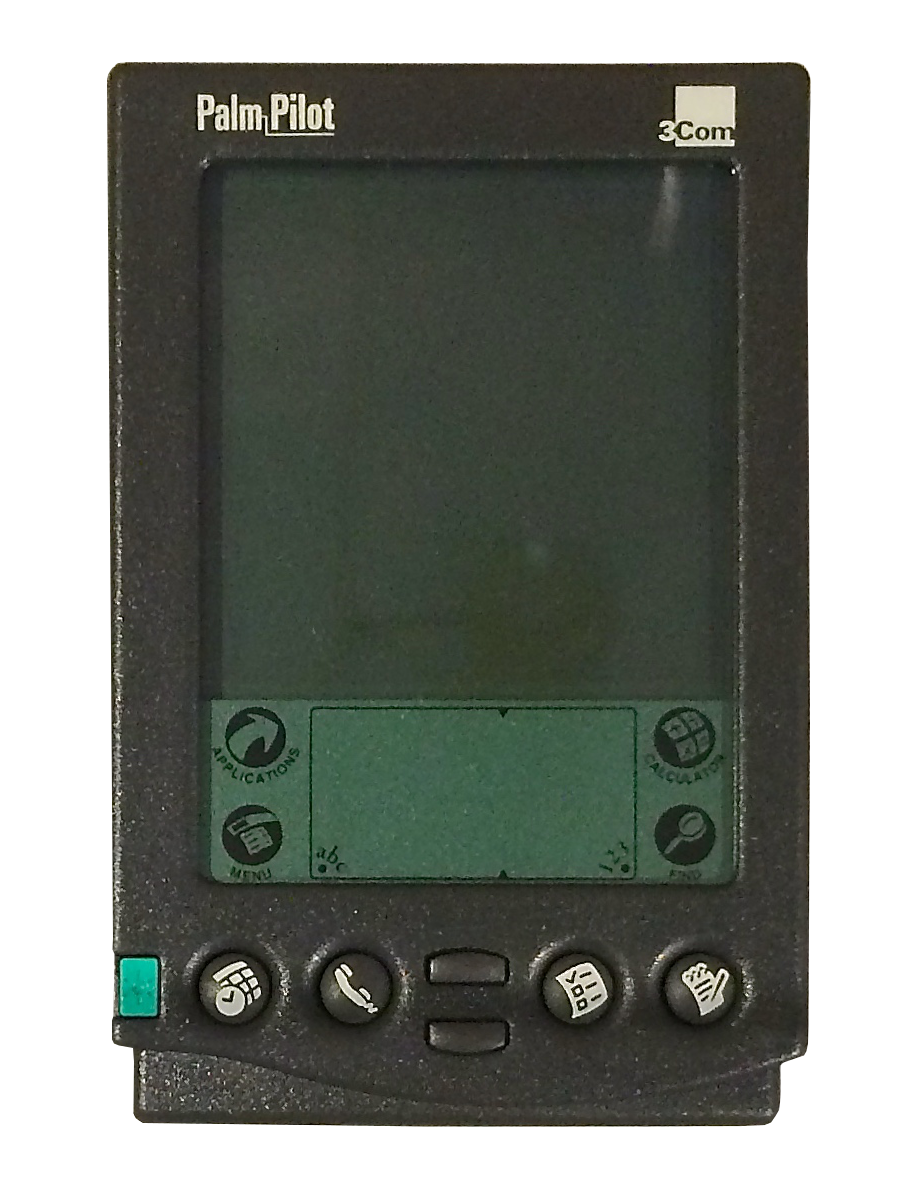
A few years later Hawkins left Palm and started Handspring, where he licensed Palm OS and continued refining his idea into the Handspring Visor. I had a number of these, and they remain one of my favorite all-time mobile devices. My Visor went everywhere with me, and I even wrote an entire 17,000 word novella, Do Over!, in Graffiti with a stylus on my Visor.
The Handspring Visor, the ultimate refinement of the original Palm Pilot idea, was 120 mm tall, 75 mm wide and 16 mm thick, weighing 153 g without any of the Springboard accessory modules that expanded its capabilities. Just 4 mm shorter than the Z Fold 8, 7 mm narrower and 6 mm thicker. Remarkably close. The Z Fold 8 would feel very familiar in Jeff Hawkins’ shirt pocket.
Both devices are basically 10:16 aspect ratios (when the Z Fold 8 is closed). There’s something to that shape. It’s considerably shorter than modern flagships’ 2:1, but it looks… right. And there’s a reason for that, and we call it phi, or the Golden Ratio.
Technically, phi is an irrational number like pi, but it’s generally approximated to 1.618:1, just a hair off 16:10, close enough to the human eye. Phi appears everywhere in nature, from spiral galaxies to sunflowers and pinecones. It’s related to the Fibonacci Sequence in mathematics, where each number is the sum of the preceding two numbers, and it’s one of those things that makes the universe feel like it makes sense. (My favorite quirk of phi is if you have a golden rectangle, 1.618 by 1, and lop off a square, the remaining rectangle is also a golden rectangle.) It’s perhaps for that reason that it’s been studied by artists for centuries, called the “Divine Proportion” by Leonardo da Vinci. It’s inherently aesthetically pleasing.
That alone would account for the Z Fold 8 looking more “right” than today’s phones, but it’s not just the outer beauty. It’s what’s inside that counts.
Open the Z Fold 8 and it morphs into a completely different device. The inner screen of the foldable is a 7.6” landscape tablet screen with a 4:3 aspect ratio. That number isn’t an accident. You’ve been looking at 4:3 rectangles all your life. TV was 4:3 for decades. Old movies and new IMAX movies are 4:3. A4 paper is a little narrower than 3:4 and letter paper is a little wider. And the original iPad was a 3:4 screen, because Apple does the math (more on that below).
At 7.6 inches, the open Z Fold 8 is startlingly close to the 7.9 inch original iPad mini, back when the iPad mini still had large side bezels and a home button. And there’s a reason why the iPad mini is a beloved form factor for reading and watching video. It’s small and light enough to hold easily with one hand, and the right shape for comics, ebooks, all but absurdly wide “cinematic” videos and productivity apps. You can put two apps side by side and still have useful space in each one.
And it’s worth noting that this is something the current crop of foldables don’t do. Most book-style foldables start out with slab proportions, then open to two slabs side by side. If a slab is two squares, one on top of the other, two together are a four by four grid of squares, which is, of course, a bigger square. (See, who says geometry can’t be fun?) And the big square screen of current foldables is… meh.
At roughly eight inches, it technically qualifies as a tablet, I guess, but not a very good one. The problem is that the square screen makes it a jack of all trades, master of none. It’s not particularly good at anything. It’s too wide for portrait text, and too tall for landscape video. In both cases, you end up with vast gutters on either side of the content, wasting a big chunk of that eight inch screen, and your usable content isn’t much bigger than large phone like the iPhone Pro Max or the Samsung Galaxy Ultra. The Z Fold 8, though, is like a bezel-free iPad mini. The size and shape of a Kindle when reading, and able play videos without losing half the screen to black letterbox bars.
So the Z Fold 8 is two devices in one. Instead of a big phone that becomes a bigger phone, it’s essentially an all-screen Palm Pilot that unfolds into an iPad mini. Ergonomic perfection in both modes, no compromises. I’ve waited twenty years for mobile devices to remember that they’re supposed to be used by humans, that there’s more to design than numbers on a spec sheet. And finally, we’re getting them.
I couldn’t let this go without a couple of caveats.
First, shout out to Google, who accidentally got it almost right with the original Pixel Fold, which was much closer to the passport-style form factor than other foldables on the market. It had a 5.8” outer screen and a 7.6” 6:5 inner screen. Not 4:3, but at least not square. The problem was that Google was basically copying a Chinese manufacturer and didn’t understand why the form factor worked. So when everyone else kept going with “slab, but doubled,” they didn’t have a reason to stand their ground and went with the herd, the Pixel 9 Pro Fold being taller and square when open.
Second, speaking of copying, I can’t give Samsung all the credit for the Z Fold 8, either. Samsung has always had a thing for copying Apple, to the point where Steve Jobs sued them for the original Galaxy S being a blatant rip off of the iPhone 3G, right down to the icon design. And while they try to be more subtle about it now, they can’t help themselves. The Z Fold 8’s dramatic new form factor likely didn’t start in a design drawing in South Korea, but a supply chain report out of China.
Later this year, Apple is going to announce their first foldable iPhone, the iPhone Ultra. It’s a passport-style foldable, with nearly identical dimensions to the Z Fold 8. Essentially, the word on the street is Samsung got wind of what Apple was planning, then used their existing supply chain and experience making foldables to beat the iPhone Ultra to market with an iPhone Ultra clone. So like Google, I’m not sure Samsung knows why the Z Fold 8 works. They could just be copying Apple’s homework. Fortunately, Apple does sweat the details and I’m pretty sure they did the math and picked this size and shape for the reasons I listed above. (And if it wasn’t for Apple’s high-handed arrogance about keeping people in their walled garden, I would have seriously considered getting the iPhone Ultra. But that’s another story.)
The point is, Palm found the shape experimentally. Apple seems to have rediscovered it analytically. Samsung may be reproducing it competitively. But good geometry remains good geometry regardless of why a company chose it.
I miss my palm pilot