
I am not a pantser. You should know that about me. I’ve tried, particularly during NaNoWriMo, back when that was still a thing. I love Stephen King’s characterization of novels as Found Things, like fossils in the ground, and the best writers break as little as possible when exposing them to the world. But I’ve also been a Stephen King fan for decades, and I will freely admit that sometimes when you make it up as you go along, you don’t stick the landing. I’d say roughly half of his books, in my experience, end with the reader going, “Huh. I guess that happened.”
I used to be right there with him, though. I’ve been a storyteller since I was old enough to talk. When I was 5—just weeks away from 6—George Lucas opened my head, poured in Joseph Campbell’s monomyth and the three-act structure, then hit frappe. When I was 7, I would stand in front of classrooms full of older kids I didn’t know and improv fables, complete with morals, different every time. There is a born storyteller inside my brain somewhere, with an instinctual knowledge of what works and what doesn’t in human stories.
But somewhere along the way, I decided I couldn’t trust that part of my brain. I’m sure part of it is the executive dysfunction that comes with ADHD, and some of it the sheer complexity of a 80,000-word novel versus a 500-word fable, but over time I became a plotter. And thanks to my autism, a very thorough plotter. I have outlines, sure, lots of writers have outlines. But I have story bibles, character dossiers, vast bibliographies of research, all hyperlinked together in Obsidian. These days I have tens of thousands of words of conversation with my AI about the story as I hone the outline, characters and setting. By the time I write the first word of narrative, I know the story backwards and forwards.
At least, I think I do.
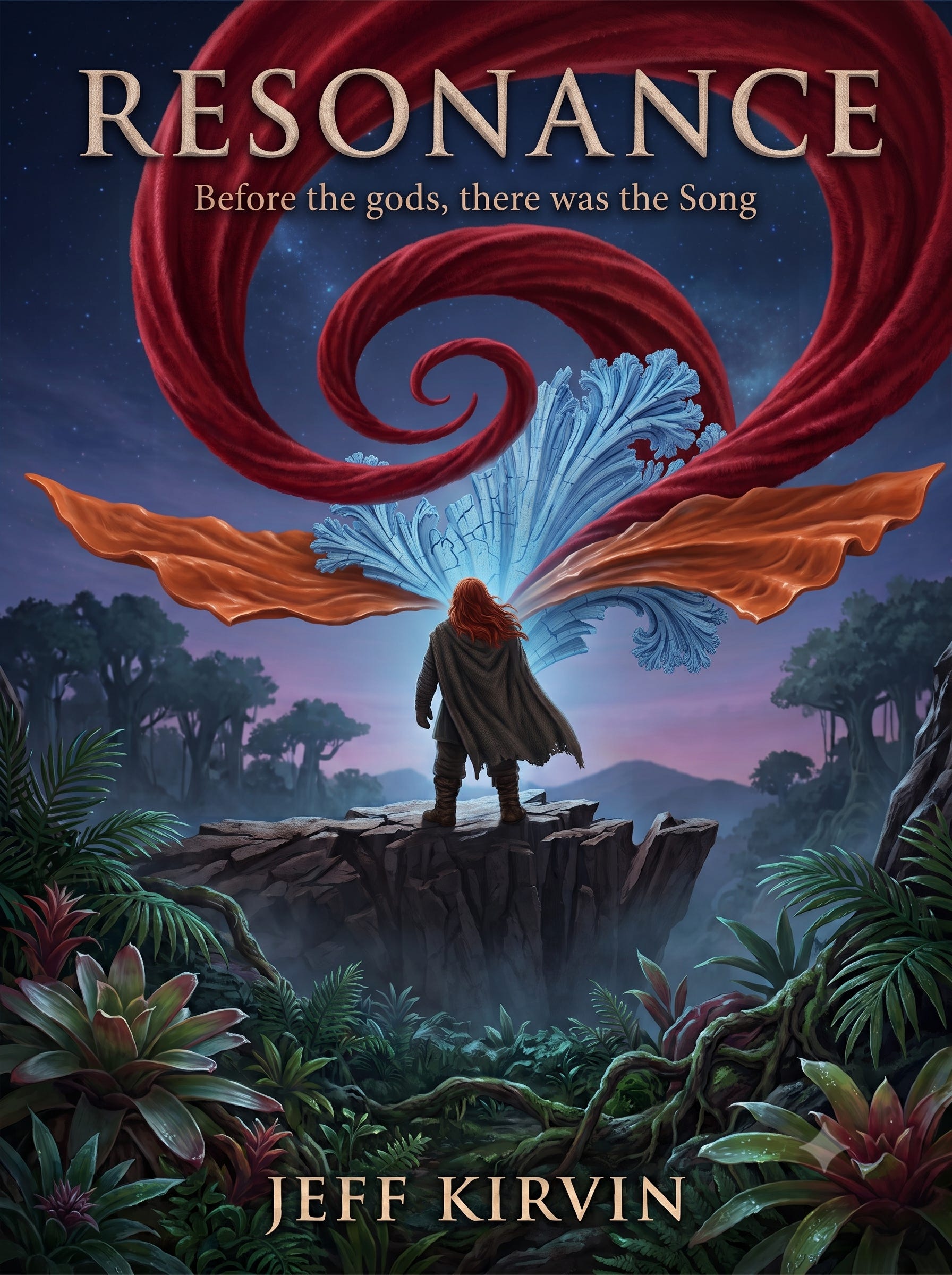
Because from Juneteenth 2025 to Juneteenth 2026, I conceived, developed, drafted, revised and polished two 75,000 word novels: Resonance, a mythic fantasy, and Hunger Never Sleeps, a modern day archeological biothriller. And both books, by the time I got to the end, ended up surprising me. Not with what happened, but what it was about.
In Resonance, the main character Vo’hanar has to make a big decision at the end of the book. I knew from the beginning what he would do. What he had to do, because that’s what the myth dictated. And I thought I knew why he did it.
But 70,000 words into the book, after writing about these people for months, I was wrong. He still makes the same decision, but the reason for it is so much deeper, more nuanced and more satisfying than I ever could have planned. (I know this is a weird, obtuse way to discuss this, but as River Song says, “Spoilers…”)
And the thing is, I don’t think I was really wrong. At least, not all of me. I think that instinctual storyteller deep inside knew all along why Vo’hanar made the choice he did, the only choice he could make and be true to himself. But my conscious mind, my facile surface plotter, guessed wrong. And the storyteller beneath just nodded, smirked and kept writing.
Something similar happened with Becky, one of the protagonists in Hunger Never Sleeps. I knew from the beginning how the book ends, but why she makes a fateful choice at the climax wasn’t quite what I expected. In retrospect, it’s perfectly fitting with her character. But these kinds of nuances don’t show up in the outline. They don’t even show up in character summaries written before the book. Those are written before I know the characters as people.
No matter how much you prepare, there are some things about the story and character that can only be revealed in the writing, living with these people day after day. I think that’s part of the fun of writing. Even for a hyper-organized plotter like myself, the characters will teach you things if you listen. I knew Resonance was a mythic fantasy about a man remembered as a god. I didn’t know it was a deeply emotional reflection on grief, fatherhood and letting go until I wrote it.
I knew the plot. But I had to write the book to find out what the story was about.
I’ve always liked that Stephen King image as well. Excavation.