The Atlantic had an interesting article about Pangram in schools last week. They describe the difficulties universities are having trying to weed out AI in written assignments, noting that Pangram in particular has gotten much, much better at avoiding false positive accusations, but even it remains vulnerable to “humanizer” AI utilities that use AI to prevent the AI detector from detecting AI by adding errors and quirks to the text. (Yes, this is turning into a Monty Python skit.)
The panic here seems to be that students are “outsourcing their thinking” to machines. But really, what thinking?
Students are using AI as an oracle because that’s all they were ever taught to do. To them, ChatGPT is just a better Google. Back in the day, Google could give them twenty sources on the French Revolution, but they’d still have to stitch all that together themselves. Now the computer can do that too. But as any teacher working the last quarter century can tell you, just because a student was able to assemble an essay doesn’t mean they understood what it said.
We’ve made students experts in regurgitating information. But to borrow an aphorism from one of my favorite books, “information is not knowledge.”
The problem, really, is that for the last half century, we haven’t bothered to teach kids how to think. What we have done is taught them to produce the right answer. That’s what our educational system is optimized for. Retrieval, not analysis. Since the dawn of standardized testing, we’ve taught kids that there is one and only one “correct” answer and how to solve for it. We haven’t bothered to teach them why it’s the right answer. We haven’t fostered curiosity about how the other answers could be interpreted. All we care about is how fast the train gets from New York to Chicago. This single-minded “teaching to the test” prepares them for the requirements of twentieth century capitalism: produce the expected result and don’t ask questions.
The problem is that the twenty-first century already demands more. Thanks to AI, providing the right answer has become trivial. Knowing what to do with it isn’t. Now we need people who know how to think, how to guide the AI to what they need. Learning how to think, how to question assumptions, how to connect things no one else saw to connect is the best education, and we’re absolutely not doing it.
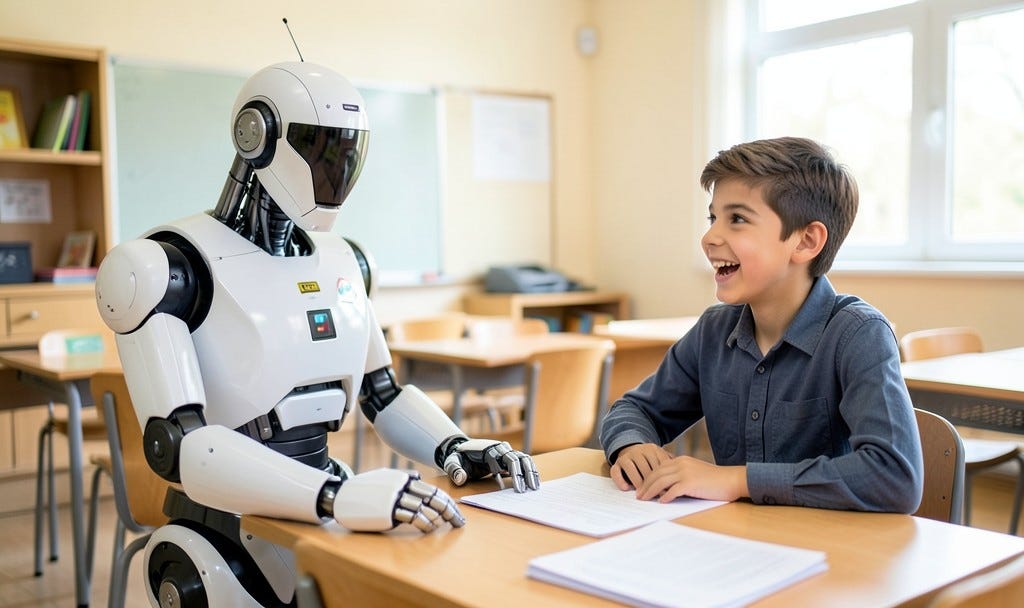
But here, too, AI could be the solution, not the disease. If AI is used to answer questions, then the doomsayers are right. It is outsourcing thinking, and the student is neither producing nor receiving anything of value. But if the AI is used to generate better questions, spurring the student to dig deeper and truly understand the subject at hand, it can be a marvelous tool for learning. A bespoke tutor for every child, learning their interests, their tendencies, and guiding them through an educational journey as unique as their own minds. AI is the best sounding board and thinking partner the world has ever seen, but the vast, thundering majority of users never think to use it that way. Why would they? They’ve never been told that’s an option.
I don’t know if we can retrofit the old system fast enough to save the current crop of students. They may be lost, though I hope not. But we owe it to the next generation to come up with a new system that challenges them, engages them and teaches them to question everything.
Answers are cheap now. Thinking isn’t.